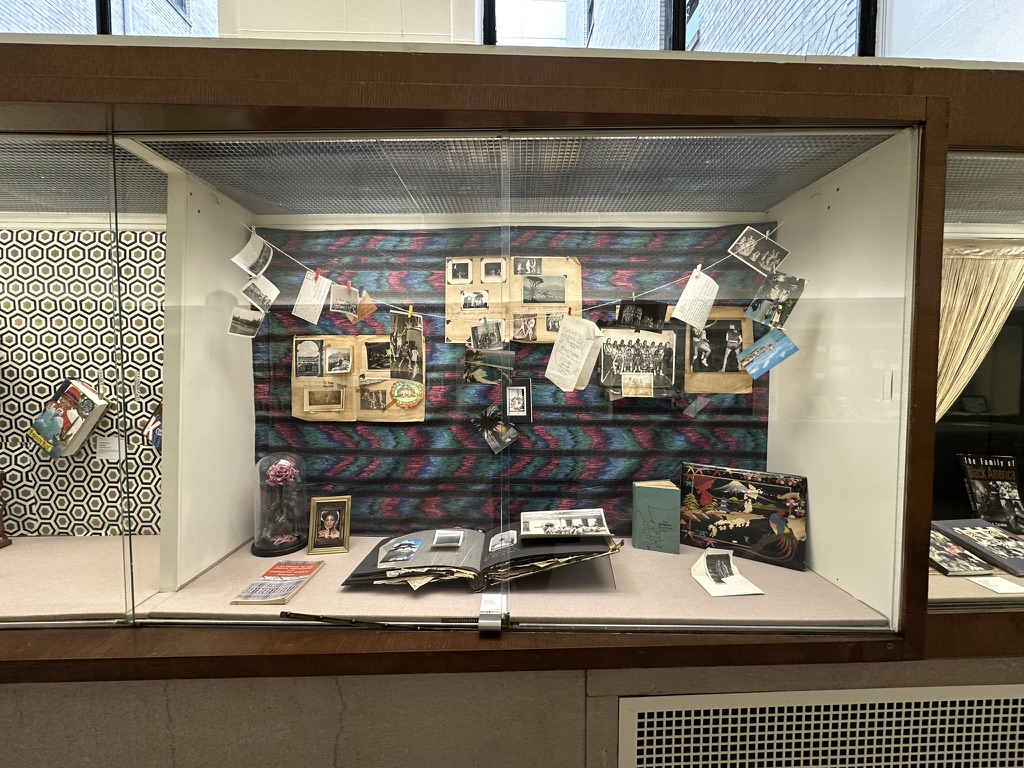
Monday January 29: COLLECTING TO WHAT ENDS?
Why do states, corporations, cultural institutions, community groups, families, individuals, and other entities create collections? What’s the point of building and stewarding a library or archive… or a shoebox full of family photographs… or a #hashtag-linked TikTok trend? Who benefits, and how? What ideals, ethics, and ideologies are embodied in these assemblages? This week we’ll explore just a few possible answers to these questions, and our collaborative work throughout the semester will undoubtedly surface more.
To Read / Do Before Class Today:
- If you haven’t done so already, please sign up for your Reading Response date!
- I unfortunately had a hard time finding an accessible, engaging, and inclusive —but also relatively short! — text theorizing “collection” itself, so I’ll share a few theories and definitions with you in class.
- I’ve long been a champion and scholar of, and a collaborative partner to, libraries 😊They’re worthy of celebration, but not immune to critique. Read Shannon Mattern, “Fugitive Libraries,” Places (October 2019). Recent debates over censorship and licensing have reinvigorated discussions about libraries’ purpose and value.
- If you’re not familiar with the concept of the “commons,” read “About the Commons,” International Association for the Study of the Commons.
- What if we traced a single painting, Modigliani’s “Seated Man with a Cane,” through various collections – from private collectors’ homes and looted stashes, to auction houses and storage facilities, to an object’s documentation in a cache, or collection, of leaked data? Listen to Ben Brock Johnson and Nora Sacks, “High-Tech Storage Dungeons and the Cultural Treasures Hidden Inside,” WBUR [audio: 37:26].
- Finally, watch John Oliver, “Data Brokers,” Last Week Tonight with John Oliver (April 11, 2022) [video: 25:09]. Consider: what other entities collect data? Law enforcement, medical professionals, scientific communities, etc? To what ends?

Wednesday January 31: CURATION AS A MEANS OF INTRODUCTION
I hope that by today our group’s composition will have settled, for the most part, and we can start to get to know one another. I invite each of you to curate a mini autobiographical ”collection” to introduce yourself to us. We’ll look at a few art projects for inspiration, then use a collaborative Google Slide deck as our exhibition platform 🎨 We’ll each have five minutes to present in class.
To Do Before Today’s Class:
- Explore the Barbican’s 2015 Magnificent Obsessions: Artist as Collector exhibition and watch this Financial Times video about the show [6:02].
- Explore Song Dong’s Waste Not, exhibited at the Museum of Modern Art in 2009.
- Read about Yuji Agematsu’s collections, which require careful observation and cultivate appreciation for things to which we typically ascribe no value: Matthew Shen Goodman, “Yuji Agematsu Gives Order to the World’s Cast-Off Crumbs,” Frieze (August 19, 2015) and watch this video from MoMA PS1 [4:32].
- Add your collections, in three or four slides, to our collaborative slidedeck:
- A title slide with your name, pronouns, major, year, and any other details you’d like us to know about you; feel free to add a photo or graphics, if you like!
- Optional: A photo of your favorite personal collection: Do you collect handbags? Sneakers? Books? Is there a thematic thread linking the images you save on Instagram? Have you curated weirdly specific Spotify playlists? I’ve made this optional because not everyone collects — or is conscious of their accidental acts of curation 😉
- A slide featuring a real or hypothetical collection — of tools, objects, artifacts, apps, digital files, etc. — that’s centrally useful to your own fields of research and practice or your extracurricular commitments and hobbies. If you’re a science major, maybe lab equipment? An English major: books or pdfs? A cook: maybe spices? An athlete: maybe you’ve got a collection of hockey sticks… or bruises? You might choose to assemble material objects IRL and take a photo, or create a collage from your own screenshots or found images (please add citations!).
- A slide featuring a hypothetical AI-curated installation: If a data broker (which you’ll recall from last week!) were tracking all of your online activity for the past month, how might its AI curator compile a collection for you? What would its artificially intelligent agents assume you like and care about?
Supplemental Resources: Collecting to What Ends?
- Walter Benjamin, “Unpacking My Library: A Talk About Book Collecting.”
- Tony Bennett et al Collecting, Ordering, Governing: Anthropology, Museums, and Liberal Government (Duke University Press, 2017): 24-7.
- Graham Bowley and Doreen Carvajal, “One of the World’s Greatest Art Collections Hides Behind This Fence,” The New York Times (May 28, 2016).
- Jason Camlot, Martha Langford, and Linda M. Morra, eds., Collection Thinking: Within and Without Libraries, Archives, and Museums (Routledge, 2023): 29-30.
- James Currall, Michael Moss, and Susan Stuart, “What Is a Collection?” Archivaria 58 (Fall 2004).
- Sam Knight, “The Bouvier Affair,” The New Yorker (January 31, 2016).
- Susan M. Pearce, On Collecting: An Investigation into Collecting in the European Tradition (Routledge, 2005): 27.
- Annie Pfeifer, “Introduction: Dangerous Passions” in To the Collector Belong the Spoils: Modernism and the Art of Appropriation (Cornell University Press, 2023): 1-15; stop at “Plan of the Book.”